
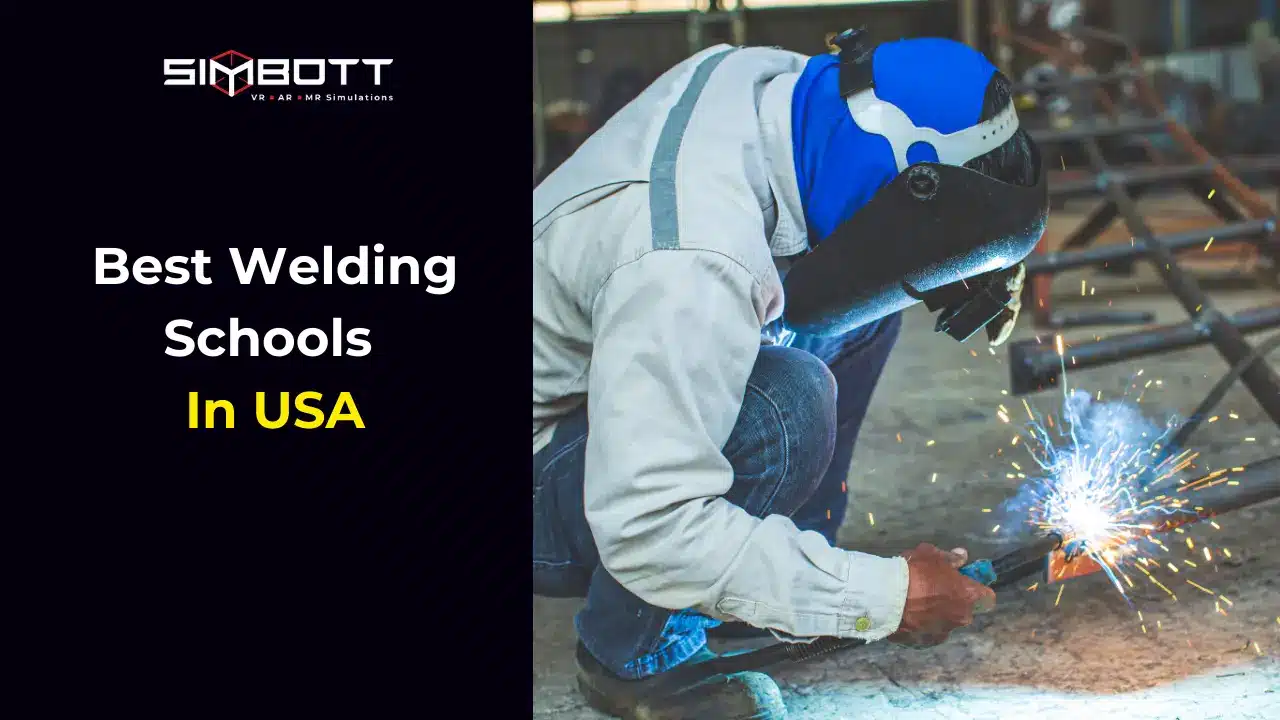
Welding is one of the most in-demand skilled trades in the United States, with opportunities across industries such as construction, manufacturing, aerospace, shipbuilding, and energy. However, becoming a successful welder requires more than just basic training — it requires hands-on experience, industry certifications, and guidance from a reputable welding school.
The best welding schools in the USA offer specialized programs designed to teach essential welding techniques such as MIG, TIG, Stick (SMAW), and Flux-Cored welding, along with blueprint reading, metal fabrication, and safety practices.
Many modern institutes also incorporate advanced welding simulators and virtual reality training, allowing students to practice welding techniques in a controlled learning environment before working with real equipment.
In this guide, we’ve compiled a list of 15+ top welding schools in the United States for 2026 based on factors such as program quality, hands-on training facilities, certification opportunities, graduate success rates, and industry reputation.
Whether you’re looking for a short-term welding certificate program, technical training, or a full welding engineering degree, these schools provide the skills and experience needed to build a successful career in the welding industry.
Top 15 Best Welding Schools In USA (2026) (Latest List)

1. The Lincoln Electric Welding School (Euclid, Ohio)
Located in Euclid, Ohio, The Lincoln Electric Welding School focuses exclusively on welding education. With over 160 booths and the latest welding and cutting equipment, students receive extensive hands-on training. The school also features a virtual reality training lab, which provides additional opportunities for practice and skill mastery.
2. Hobart Institute of Welding Technology (Troy, Ohio)
The Hobart Institute of Welding Technology is renowned for its comprehensive 24-week Pathways Welding program, which focuses on all-position welding. This institute is known for producing highly skilled graduates who are competitive in the welding industry. Their commitment to providing a well-rounded education in welding makes them a top choice.
3. Advanced Welding Institute (Vermont & Wisconsin)
With campuses in Vermont and Wisconsin, the Advanced Welding Institute offers individualized instruction and accelerated programs ranging from 40 hours to 24 weeks. The institute is accredited by the Accrediting Commission of Career Schools and Colleges, ensuring high-quality education and hands-on training in welding.
4. Modern Welding School (Schenectady, New York)
Modern Welding School in Schenectady, New York, offers a 30-week program that prepares students for careers in welding through extensive hands-on practice. Applicants must be at least 18 years old and capable of meeting physical requirements such as lifting 50 pounds and working in various positions.
5. Welder Training & Testing Institute (Allentown, Pennsylvania)
The Welder Training & Testing Institute in Allentown, Pennsylvania, not only trains aspiring welders but also offers industrial services such as testing and inspection. The institute provides flexible scheduling and courses that prepare students for national standardized exams, making it a top choice for those looking to enter the welding industry.
6. Tulsa Welding School (Tulsa, Oklahoma; Jacksonville, Florida; Houston, Texas)
With campuses in Oklahoma, Florida, and Texas, Tulsa Welding School offers multiple disciplines, including welding, refrigeration, and electro-mechanical technologies. Their Professional Welder program can be completed in just seven months, preparing students for entry-level positions in the welding field.
7. Davis Technical College (Kaysville, Utah)
Davis Technical College in Kaysville, Utah, offers a welding technology program that can be completed in about 10 months. With start dates every two weeks and 18-hour weekly classes, students enjoy flexible scheduling and a comprehensive curriculum that covers various welding techniques.
8. Collins Career Technical Center (Chesapeake, Ohio)
Collins Career Technical Center provides a nine-month welding program that teaches various welding techniques, including blueprint interpretation. Evening classes make this program convenient for working students who want to advance their welding skills.
9. Wichita State University Campus of Applied Sciences and Technology (Wichita, Kansas)
Wichita State University’s welding program covers a range of welding techniques, including shielded metal arc welding and gas tungsten arc welding. Students can earn a Technical Certificate in as little as one year, with a curriculum that combines classroom instruction and hands-on lab experience.
10. Renton Technical College (Renton, Washington)
Renton Technical College offers a flexible welding program that ranges from 22 to 105 credits, depending on the desired certification. The college also offers an Associate of Applied Science degree for students seeking more advanced training in welding.
11. Universal Technical Institute (Locations Across 9 States)
With locations in nine states, Universal Technical Institute (UTI) offers a curriculum that prepares students to become combination welders in less than nine months. Partnering with Lincoln Electric, UTI provides students with industry-recognized training and the skills needed for a successful career in welding.
12. Lorenzo Walker Technical College (Naples, Florida)
Lorenzo Walker Technical College offers specialized programs in pipefitting, artistic welding, and fabrication technology. With a 79% placement rate after graduation, the college provides students with a well-rounded education that prepares them for a variety of welding careers.
13. Lakeshore Technical College (Cleveland, Wisconsin)
Lakeshore Technical College in Cleveland, Wisconsin, emphasizes hands-on training in its welding program, which takes place over two terms. The college is an accredited test facility for the American Welding Society, ensuring that students receive high-quality education and certification opportunities.
14. Arizona Automotive Institute (Glendale, Arizona)
Arizona Automotive Institute (AAI) in Glendale offers flexible class schedules and hands-on training focused on the automotive industry. Their welding program prepares students for careers in custom art, industrial architecture, and other specialized fields within the industry.
15. Elite Welding Academy (Cincinnati, Ohio)
Elite Welding Academy in Cincinnati offers comprehensive welding programs with small class sizes for a more individualized learning experience. Graduates are well-prepared for careers in manufacturing, construction, and pipeline work, making this academy a top choice for aspiring welders.
16. Ferris State University (Big Rapids, Michigan)
Ferris State University offers both a Bachelor of Science degree in Welding Engineering Technology and an Associate in Applied Science in Welding Technology. The university’s state-of-the-art welding lab and expanded facilities provide students with top-notch training and the skills needed to excel in the welding industry.
These 16 welding schools represent some of the best options available in the USA for 2024. Each school offers unique programs and opportunities for hands-on learning, ensuring that graduates are well-prepared to enter the welding industry with confidence. Whether you’re looking for a short-term certificate or a comprehensive degree, these schools provide the education and training needed to succeed in the dynamic field of welding.
5 Things You Need to Check Before Joining a Welding Course in the USA
1. Does the School Offer Virtual Reality (VR) or Augmented Reality (AR) Welding Training?
This should be your first priority. Many leading welding schools in the USA now use Virtual Reality (VR) and Augmented Reality (AR) welding simulators to help students learn faster and more efficiently. These simulators provide a realistic welding experience while giving instant feedback on travel speed, work angle, torch angle, arc length, and welding technique. Students can practice repeatedly without consuming filler metal, gas, or steel, making VR training one of the fastest ways to build confidence before moving to live welding.
See our Simbott Welding Simulator
2. Is There Enough Hands-On Practical Training?
A quality welding program should emphasize practical training. Look for schools that provide extensive lab hours where students practice welding using industry-standard equipment. Training should include multiple welding processes such as MIG (GMAW), TIG (GTAW), Stick (SMAW), Flux-Cored (FCAW), and Pipe Welding.
3. Are the Instructors Certified and Industry Experienced?
Choose a welding school with instructors who have years of field experience and industry-recognized certifications. Experienced welders can teach proper welding techniques, safety procedures, blueprint reading, welding codes, and inspection standards used in real manufacturing environments.
4. Does the Program Prepare You for AWS Certifications?
The best welding schools prepare students for American Welding Society (AWS) certifications. AWS certifications are recognized throughout the United States and are highly valued by employers in manufacturing, construction, shipbuilding, aerospace, and energy industries.
5. Does the School Provide Job Placement Assistance?
Many technical colleges and trade schools partner with local manufacturers, fabrication shops, shipyards, and construction companies. Choose a school that offers career services, apprenticeships, internships, resume assistance, and job placement support after graduation.
Top Welding Courses in the USA
If you’re planning to become a professional welder, these are some of the most popular welding courses available across the United States.
| Course Name | Duration | Best For |
|---|---|---|
| Welding Technology Certificate | 6–12 Months | Beginners entering the welding industry |
| Welding Diploma Program | 9–18 Months | Hands-on career-focused training |
| Associate Degree in Welding Technology | 2 Years | Advanced technical and supervisory careers |
| Structural Welding Course | 3–6 Months | Construction and steel fabrication |
| Pipe Welding Course | 3–6 Months | Oil & gas, power plants, and pipelines |
| MIG (GMAW) Welding Course | 1–3 Months | Manufacturing and automotive industries |
| TIG (GTAW) Welding Course | 1–3 Months | Aerospace, stainless steel, and aluminum welding |
| Stick Welding (SMAW) Course | 1–2 Months | Construction and heavy fabrication |
| Flux-Cored Arc Welding (FCAW) Course | 1–3 Months | Heavy industrial fabrication |
| Combination Welding Program | 6–12 Months | Learning multiple welding processes |
| Robotic Welding and Automation Course | 3–6 Months | Automated manufacturing careers |
| Welding Inspection Course | 2–8 Weeks | Quality assurance and inspection careers |
| Certified Welding Inspector (CWI) Preparation | Varies | Experienced welding professionals |
| Underwater Welding Training | Specialized | Offshore, marine, and commercial diving careers |
| Welding Fabrication Technology Program | 6–12 Months | Metal fabrication and production industries |
Most In-Demand Welding Skills
Stick Welding (SMAW)
One of the most widely used welding processes in construction, shipbuilding, and heavy fabrication.
MIG Welding (GMAW)
Commonly used in manufacturing, automotive production, and metal fabrication because of its speed and efficiency.
TIG Welding (GTAW)
Ideal for precision welding on stainless steel, aluminum, and aerospace components.
Flux-Cored Arc Welding (FCAW)
Preferred for structural steel, shipbuilding, and outdoor industrial applications.
Pipe Welding
Highly valued in oil & gas, power generation, and pipeline construction.
Structural Welding
Used in bridges, commercial buildings, and steel structures.
Aluminum Welding
Important for aerospace, automotive, marine, and transportation industries.
Stainless Steel Welding
Common in food processing, pharmaceutical, and medical equipment manufacturing.
Blueprint Reading
Understanding welding symbols and fabrication drawings is an essential skill for professional welders.
Welding Safety and Inspection
Knowledge of OSHA safety standards, welding procedures, and inspection methods is highly valued by employers.
Best Welding Certifications for a Higher Salary
AWS Certified Welder (CW)
The most recognized welding certification for entry-level and experienced welders in the United States.
AWS Certified Welding Inspector (CWI)
One of the highest-paying certifications for professionals working in welding inspection and quality control.
ASME Section IX Welder Qualification
Required for pressure vessels, boilers, and power generation industries.
API 1104 Certification
Widely recognized for pipeline welding in the oil and gas industry.
Certified Welding Educator (CWE)
Ideal for experienced welders interested in teaching welding technology.
NDT Level II Certification (UT, RT, MT, PT)
A valuable certification for careers in quality assurance and non-destructive testing.
Top Career Opportunities After Welding Courses
- Welder
- MIG Welder
- TIG Welder
- Stick Welder
- Pipe Welder
- Structural Welder
- Combo Welder
- Welding Technician
- Welding Inspector
- Quality Control Inspector
- Fabrication Technician
- Welding Supervisor
- Welding Engineer
- Aerospace Welder
- Shipyard Welder
- Oil & Gas Welder
- Robotic Welding Technician
Most welding programs in the USA are offered through community colleges, technical colleges, trade schools, union apprenticeship programs, and private welding academies. Depending on the program, training can range from a few weeks to two years and typically includes classroom instruction, extensive hands-on practice, AWS certification preparation, and real-world welding experience using industry-standard equipment.
FAQs About Top Welding Schools in the USA
What are the average tuition costs for welding programs in the United States?
Tuition can vary significantly depending on the specific institute, program length, and location. However, you can generally expect to pay between $5,000 and $15,000 for a welding program. Some community colleges may offer more affordable options, while specialized welding schools might have higher tuition rates.
How long does it typically take to complete a welding training program in the USA?
Most welding programs last between 6 months to 2 years, depending on the level of certification and specialization. Shorter programs might focus on specific welding processes, while longer programs offer a more comprehensive curriculum.
What types of welding certifications can I obtain through welding training in the USA?
Common certifications include:
AWS (American Welding Society) Certifications: These certifications are widely recognized in the industry and cover various welding processes, including CWI (Certified Welding Inspector) and certifications for specific welding techniques.
ASME (American Society of Mechanical Engineers) Certifications: These certifications are often required for welding in the pressure vessel and piping industries.
Are there any job placement assistance programs offered by welding training institutes in the USA?
Many welding schools collaborate with industries to provide job placement assistance for their graduates. Inquire about the institute’s specific programs and success rates in placing students in welding jobs.
What is the average salary for a welder in the United States?
The average salary for a welder in the United States varies depending on experience, location, specialization, and industry. However, you can expect to earn a competitive salary, with experienced welders often earning $40,000 to $70,000 per year or more.
What should you look for when choosing a welding school in the USA?
When selecting a welding school, consider factors such as accreditation, hands-on training facilities, instructor experience, certification preparation, job placement support, and industry partnerships. Schools that provide modern equipment and real-world training environments typically offer better career outcomes.
Do welding schools in the USA provide financial aid or scholarships?
Many welding schools offer financial aid, scholarships, grants, and payment plans to help students cover tuition costs. Some technical colleges also participate in federal financial aid programs, while certain employers and trade organizations may sponsor welding training for qualified candidates.
Can international students enroll in welding schools in the United States?
Yes, several welding institutes and technical colleges accept international students. However, applicants usually need to meet requirements such as student visas, English proficiency tests, and proof of financial support before enrolling in a welding training program.
You’ll Also Like:
16 Welding Safety Tips & Rules Must Know
11 Reasons To Give Welding Training For Beginners