
Welding is one of the most important manufacturing and fabrication processes used across industries such as construction, automotive, aerospace, shipbuilding, oil and gas, and heavy engineering. It involves joining two or more metal parts by applying heat, pressure, or a combination of both to create a strong and permanent bond.
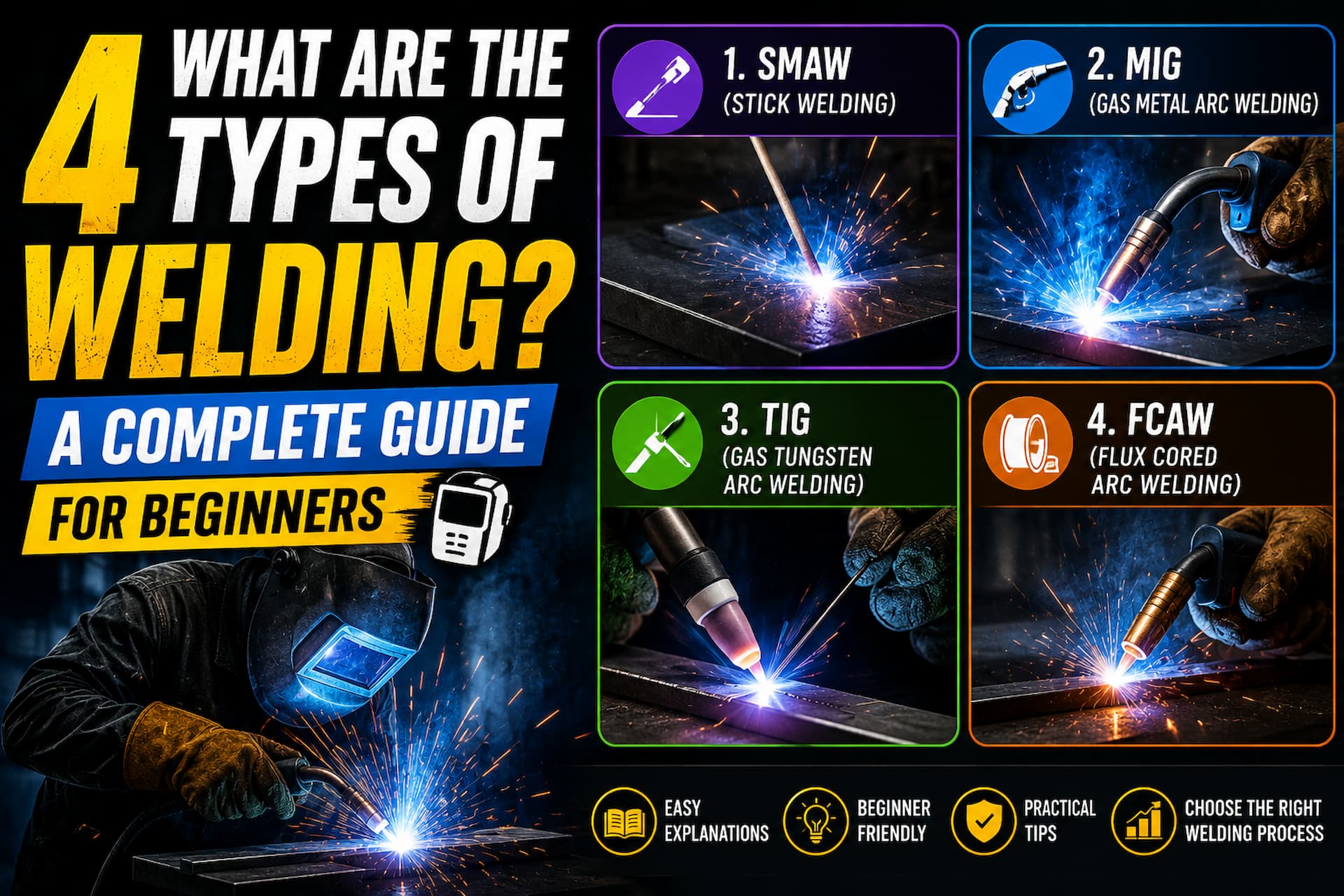
For anyone starting a career in welding or exploring industrial trades, understanding the different types of welding is essential. While there are dozens of welding techniques used worldwide, four methods are considered the most common and widely used in modern industries: MIG Welding, TIG Welding, Stick Welding, and Flux-Cored Arc Welding.
In this guide, we’ll explore these four major welding processes, their applications, advantages, limitations, and how modern technologies like the Simbott VR Welding Simulator are helping trainees master these techniques safely and efficiently.
Why Understanding Welding Types Is Important
Different welding processes are designed for different materials, thicknesses, environments, and applications. Choosing the right welding method affects:
- Weld quality
- Production speed
- Material compatibility
- Safety
- Cost efficiency
- Project durability
By understanding the strengths and limitations of each welding type, welders can select the most suitable process for their specific requirements.
1. MIG Welding (Metal Inert Gas Welding)
MIG Welding, also known as Gas Metal Arc Welding (GMAW), is one of the most popular welding methods used today. It utilizes a continuously fed wire electrode and a shielding gas to protect the weld pool from contamination.
MIG welding is widely preferred because it is relatively easy to learn and offers high productivity. The process creates clean welds with minimal post-weld cleanup, making it suitable for both beginners and experienced welders.
Common Applications of MIG Welding
- Automotive manufacturing
- Structural fabrication
- Industrial machinery
- Sheet metal work
- Repair and maintenance projects
Advantages of MIG Welding
- Easy to learn and operate
- High welding speed
- Clean and smooth welds
- Suitable for thin and thick materials
- Minimal slag production
Limitations of MIG Welding
- Requires shielding gas
- Less effective in outdoor windy conditions
- Equipment can be more expensive than some alternatives
2. TIG Welding (Tungsten Inert Gas Welding)
TIG Welding, also called Gas Tungsten Arc Welding (GTAW), is known for producing some of the highest-quality welds available. The process uses a non-consumable tungsten electrode and shielding gas to create precise and clean welds.
TIG welding requires greater skill and control compared to MIG welding but provides superior aesthetics and accuracy.
Common Applications of TIG Welding
- Aerospace components
- Stainless steel fabrication
- Food-grade equipment
- Medical devices
- Precision engineering
Advantages of TIG Welding
- Exceptional weld quality
- Precise control
- Suitable for thin materials
- Produces attractive welds
- Works with a wide range of metals
Limitations of TIG Welding
- Slower process
- Requires higher skill levels
- Lower productivity compared to MIG welding
3. Stick Welding (Shielded Metal Arc Welding)
Stick Welding, officially known as Shielded Metal Arc Welding (SMAW), is one of the oldest and most versatile welding methods. It uses a consumable electrode coated in flux, which creates a protective gas shield during welding.
Stick welding remains widely used because it performs exceptionally well in outdoor environments and challenging job site conditions.
Common Applications of Stick Welding
- Construction projects
- Pipeline welding
- Shipbuilding
- Infrastructure maintenance
- Heavy equipment repair
Advantages of Stick Welding
- Works well outdoors
- Portable equipment
- Effective on rusty or dirty metal
- Cost-effective setup
- Suitable for thick materials
Limitations of Stick Welding
- More slag production
- Requires frequent electrode changes
- Higher cleanup requirements
4. Flux-Cored Arc Welding (FCAW)
Flux-Cored Arc Welding is similar to MIG welding but uses a tubular wire filled with flux instead of relying entirely on shielding gas. This makes it highly effective for heavy-duty industrial applications.
FCAW is known for its high deposition rates and ability to weld thick materials quickly.
Common Applications of Flux-Cored Arc Welding
- Structural steel fabrication
- Heavy construction
- Shipbuilding
- Industrial manufacturing
- Outdoor welding projects
Advantages of Flux-Cored Arc Welding
- High welding speed
- Deep penetration
- Excellent for thick materials
- Suitable for outdoor environments
- High productivity
Limitations of Flux-Cored Arc Welding
- Produces more fumes
- Requires slag removal
- Can create more spatter
Comparison of the 4 Main Types of Welding
| Welding Type | Difficulty Level | Weld Quality | Speed | Best For |
| MIG Welding | Easy | High | Fast | Manufacturing, automotive, fabrication |
| TIG Welding | Advanced | Very High | Slow | Aerospace, precision work, stainless steel |
| Stick Welding | Moderate | Good | Moderate | Construction, repair, outdoor work |
| Flux-Cored Welding | Moderate | High | Very Fast | Heavy industry, structural steel |
How to Learn Different Welding Types Safely
Traditional welding training often requires expensive consumables, dedicated workshops, and strict safety precautions. Beginners frequently face challenges such as improper torch angles, incorrect travel speeds, and poor welding techniques.
Today, many training institutions and industries are adopting Virtual Reality welding training to help learners master welding fundamentals before working with actual equipment.
Simbott VR Welding Simulator
The Simbott Welding Simulator is designed to help students, trainees, and industrial workers learn different welding techniques in a realistic and risk-free virtual environment.
The simulator allows users to practice:
- MIG Welding
- TIG Welding
- Stick Welding (SMAW)
- Various welding positions
- Joint preparation techniques
- Welding safety procedures
Through real-time feedback and performance analysis, trainees can identify mistakes and improve their welding skills without consuming materials or exposing themselves to workplace hazards.
Benefits of Using the Simbott VR Welding Simulator
Safer Training Environment
Trainees can practice welding without exposure to sparks, heat, fumes, or electrical hazards.
Reduced Training Costs
Organizations save money on electrodes, metal plates, shielding gas, and equipment maintenance.
Instant Performance Feedback
The simulator provides detailed analysis of torch angle, travel speed, arc length, and welding technique.
Faster Skill Development
Learners can practice repeatedly until they gain confidence and proficiency.
Sustainable Learning
Virtual welding eliminates material waste and supports environmentally responsible training.
Which Welding Type Should Beginners Learn First?
For most beginners, MIG welding is often considered the easiest welding process to learn because of its straightforward operation and forgiving nature. Once learners gain confidence with MIG welding, they can progress to TIG welding, Stick welding, and Flux-Cored welding depending on their career goals and industry requirements.
The best approach is to combine theoretical knowledge, simulation-based learning, and practical workshop experience to develop well-rounded welding skills.
Conclusion
The four main types of welding—MIG Welding, TIG Welding, Stick Welding, and Flux-Cored Arc Welding—each play a vital role in modern manufacturing, construction, and industrial operations. Every process offers unique advantages and is suited to specific applications and environments.
As welding training continues to evolve, technologies such as the Simbott VR Welding Simulator are making it easier than ever for students and professionals to learn these techniques safely, efficiently, and cost-effectively. By understanding the fundamentals of each welding method and leveraging modern training tools, aspiring welders can build the skills needed for a successful career in the industry.
Frequently Asked Questions
Which welding type is easiest to learn?
MIG welding is generally considered the easiest welding process for beginners due to its simple operation and fast learning curve.
Which welding process produces the highest quality welds?
TIG welding is known for producing the cleanest, strongest, and most visually appealing welds.
What welding method is best for outdoor work?
Stick welding is often preferred for outdoor applications because it performs well in windy conditions and on dirty surfaces.
Is Flux-Cored Welding better than MIG Welding?
Flux-Cored Welding is better suited for heavy-duty and outdoor applications, while MIG welding is often preferred for cleaner indoor environments.